
Sample Editorial Deliverable
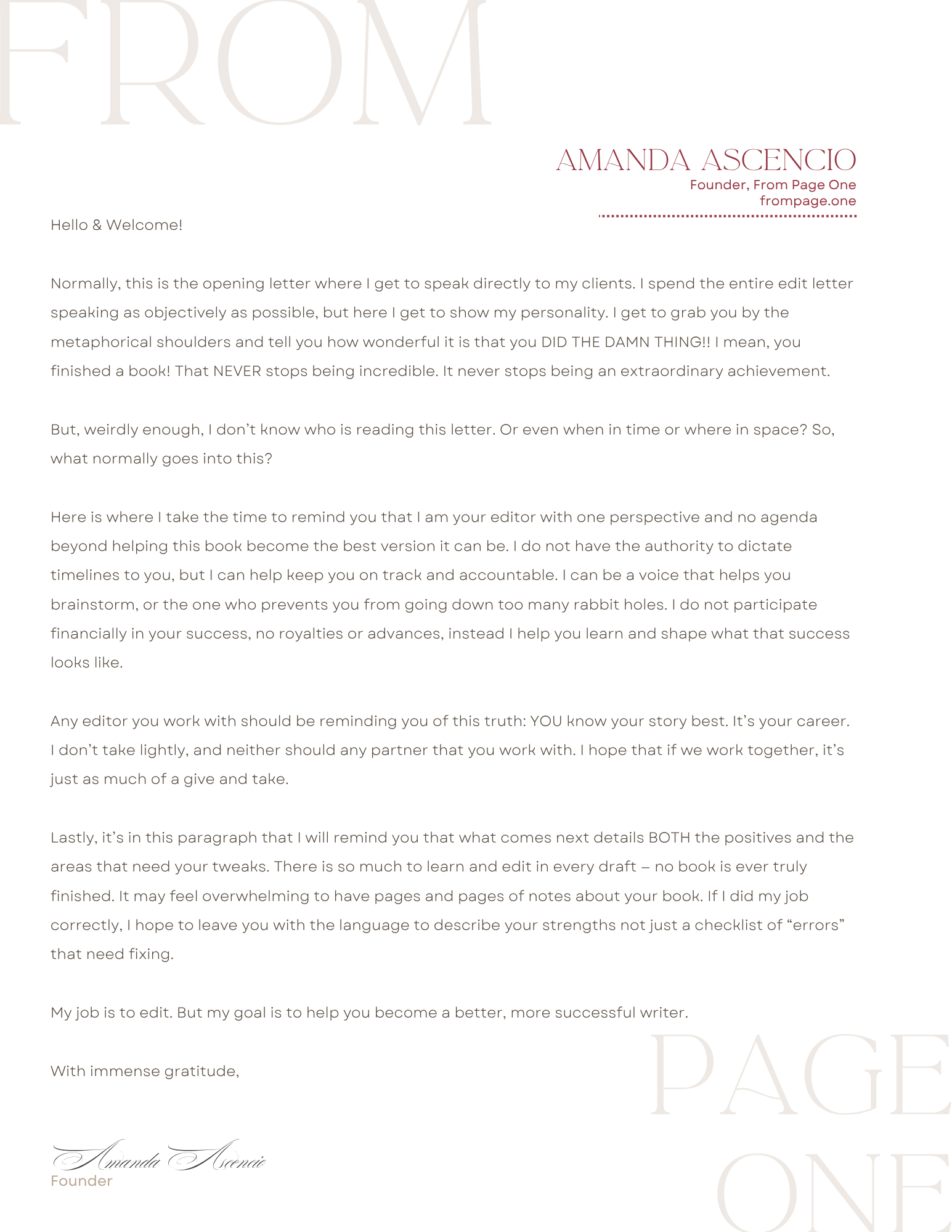
Sample developmental edit letter opening page from From Page One, featuring a welcome letter by founder Amanda Ascencio outlining her editorial philosophy and approach to working with indie and self-publishing authors.
Below is an overview of the sections included in a full edit letter, with examples. We do not write from a template. It’s a custom-made process every time, based only on what is relevant to your needs.
Contents:
Part 1: Global Substantive Assessment
Your Strengths At A Glance
Composition of a Scene
Part 2: Your Book’s Opening, Middle, and Resolution
Part 3: Manuscript-Wide Notes
Pacing & Foreshadowing
Relationships & Tension
World Building
Diversity of Representation
Summary of Revision Goals
Themes
Global Writing Style
Proofreading
Part 4: Marketability & Placement
Potential Sensitivity Readers
Proposed Logline
Proposed Summary / Blurb
Social Media Marketing & Quotes
Querying / Trad Publication
Potential Comp Titles
Conclusion
Part 1: Global Substantive Assessment
Included below are real excerpts from developmental edit letters and past work.
Your Strengths At A Glance
Your existing story structure flows very well. The narrative delivers on all genre expectations in a way that reads as continuous and logical.
The use of a dual-timeline method for the first 40% of the book is very strong in this context.
The world building felt consistent. I had no issues visualizing scenes, character and place names felt organic and aligned to your genre, and the magic system was well-executed between the protagonist and the antagonist.
To that point, your story has a very cinematic quality, both in its subject matter and in your writing style. There are multiple points in which your descriptions were beautiful to read.
You achieve this through very strong sentence construction which is both easy to understand while still nuanced and layered. Perfect for broad audience appeal.
Composition of a Scene
Inciting Incident
Turning Point (or Progressive Complication)
Crisis (or Question)
Climax (or Action / Choice)
Resolution
The opening scene of Fellowship of the Ring (movie) hits all 5 components in 7 minutes. If you have time, it’s worth watching. All of the exposition, history, and world building that you need as a viewer of the entire trilogy is explained from the perspective of the Ring as the Protagonist.
Opening (0:33) “The world is changed.”
Inciting Incident (1:10) “It began with the forging of the great rings.”
Turning Point (1:45) “But they were all of them deceived, for another ring was made.”
Crisis (4:25) “Sauron, the enemy of the free peoples of Middle Earth, was defeated.”
Climax (5:03) “The ring has a will of its own. It betrayed Isildur to his death.”
Resolution (5:30) “For two and half thousand years, it passed out of all knowledge. Until, when chance came, it ensnared a new bearer.”
Cliffhanger (6:35) “It abandoned Gollum. But something happened then the ring did not intend, it was picked up by the most unlikely creature imaginable.”
This section of the edit letter also contains headings like the below that are written especially for the details included in your manuscript.
Title
Global Genre
Chapter by Chapter Reactions
Story Structure Analysis
Scenes Not Chapters
Part 2: Your Book’s Opening, Middle, and Resolution
This section of the edit letter contains headings like the below that are written especially for the details included in your manuscript.
Opening Section: Scene by Scene Breakdown
Genre Adherence
Plot Structure Analysis
The A Plot
Set Up & Pay Off
Middle Section: Scene by Scene Breakdown
Subplot Structure
Midpoint
Climax
Ending Resolution: Scene by Scene Breakdown
Cliffhanger
Plotting: Interconnected Stand-alone
Part 3: Manuscript-Wide Notes
Included below are real excerpts from developmental edit letters and past work.
Pacing & Foreshadowing
What this helps you determine is a character’s wants versus needs. It will also help you keep track of certain plot points that must be fulfilled. For example, if a character is searching for his place in the world because he was abandoned as a child, at some point he will want to confront the parents who abandoned him or (at the very least) explore whether or not he wants to locate them.
Relationships & Tension
Therefore, it becomes vitally important that both relationships are distinguishable from the other. They both cannot follow the same path because the repetitive plot points will slow your pace and be a detriment to your story. However, if you actively position them as foils for each other, you have a fascinating mirror dynamic. You’ll have to carefully plot their trajectories such that when one is high, the other is at a low, and vice versa.
Where this hinges on is a conversation about honesty. Bella and Franklin should be able to progress romantically on the condition that: Franklin does not reveal his identity or the extent of his knowledge of the dire situation. For as long as he is willing to subject himself to the guilt and the lies, then romantically they can slow burn. They can flirt, get to know one another, confess mutual attraction, potentially even kiss – up to you on how far you’re willing to take it. However, the whole time what grows for Franklin is the guilt of realizing this is careening towards a dead end once the truth comes out.
Meanwhile, what could be holding Tyler back is a failure to be honest with himself. His overprotectiveness of Lara is really just a front. What is underneath is a fear of letting himself be happy, fear of being vulnerable to another person, and fear of being hurt. It’s a difficult thing to transition a friendship into a romantic relationship. Whatever the reason is, it must be substantial to have kept them apart for 5 years. That’s a long time and so the obstacle must be appropriately large enough in comparison to that.
The two relationships follow parallel but mirrored tracks. Where it seems like one couple are heading to bliss, the other are heading toward doom.
World Building
In your book you have established that magical ability is hereditary and you have also set a precedent that it can exist in a character’s blood line without them exhibiting ability. What could be clearer is how the magic works and what it is capable of doing. It seems to be a very internal experience since there is a lot of feeling imagery in association with the magic. There are a lot of questions about magic that I had throughout reading. Where do mages fit in the hierarchy of the world? Are they powerful and influential? Where do they normally train? What types of mages/magic exist?
Is there a cost to magic? Especially in the instance of stolen powers, is there a limit or consequence from using magic? Or not, because it's inherent to the individual? We know that it’s capable of imprisoning beings as powerful as Gods, but how does that work?
I know you want to avoid the typical “chosen one” cliche where Wynn is suddenly an expert after just a few weeks of training. I completely agree with you on this. I think adding in a drawback to magic usage could help here. It would allow you to grow Wynn’s aptitude for magic to any level you wish but limit when or how often he deploys that skill to avoid a consequence. Alternatively, you can include various levels to training to set the stage for something that is more of a lifelong pursuit.
Diversity of Representation
Something that stood out to me while reading only one character seems to be non-white. In this genre, the presence of other cultures in society is expected given the era you are citing as an influence. There is an opportunity for you to include that in your book as well, should you choose to.
Summary of Revision Goals
1. (Optional) Clarifying plot points relating to romance story beats.
2. (Optional) Explanations relating to heist plans and aligning to story beats.
3. (Optional) Refining antagonists backstory and motivations.
4. (Optional) Scaling back the unrequited romance beats.
5. Correcting tense changes throughout the book.
6. Strengthen at the sentence level.
7. Global proofreading pass.
8. Unifying formatting across chapters and adjusting Prologue, Epilogue, and chapter numbers.
Themes
As a genre, American Western stories of this time period feature a prevalent theme of anti-establishment and escape from modernism and industrialization. And it makes sense because otherwise why else would you be cheering for the group that is out here robbing banks and stealing bars of silver.
There is a lot of overlap with your decision to center a sapphic romance. It’s a meta form of the novel itself rebelling against a heteronormative society. Through your main character, you have someone by which you are exploring the dichotomy of her dueling desires: community or isolation?
Global Writing Style
Overall, because your book is in such a good place, I believe you should focus your next revision on polishing at the sentence level. A helpful trick here is to read your book out loud. Focus on one chapter at a time, and read it out loud as if you were an audiobook narrator. Your speaking pace is naturally slower than your mental reading pace (usually). And the act of hearing the words as they come together can help you locate the places you want to strengthen.
Proofreading
It’s such a good sign and speaks to the strength of your manuscript that this edit letter even includes a section on proofreading. There might be some tweaking that you decide to do in the plot, but that also shouldn’t stop you from polishing up the grammar and typos in certain places. You are very close to a finished product and after one more revision is the time to start polishing grammar at the sentence level.
Part 4: Marketability & Placement
Included below are real excerpts from past work across novels and television projects.
Potential Sensitivity Readers
Considering the themes, the backstory of the main character, and the identities of several prominent figures in the story, I strongly suggest you do some digging into the possibility of working with 1-2 sensitivity readers. Especially focusing on Chapters 4, 7, 18, and 23-26.
Proposed Logline
Aura is a wide-eyed aspiring hairstylist attending The Beverly Hills Beauty School of Palmdale, CA with Rosalie, a no-nonsense single mother on a mission to open her own salon, as they each face the trials and tests necessary to graduate.
Proposed Summary / Blurb
BEAUTY SCHOOL is a fun, irreverent portrait of the generational, cultural, and ideological clashes people have while going after their dreams and navigating the politics of washing, rinsing, and repeating. Tonally, the series is a mix of Waiting for Guffman and The Office, with a subtle spritz of Hairspray. It offers quintessentially Latino characters in ways we rarely get to see ourselves on television--awkward but resolute, awed but with heart, and cutting, dyeing, and crimping towards something brighter and better. Set at a cosmetology school in one of Palmdale, California’s finer stripmalls, BEAUTY SCHOOL is a workplace mockumentary that follows a group of dreamers, doers, and at least one person who shouldn’t be anywhere near shears. Located about an hour away from Los Angeles. Depending on traffic, of course. The Beverly Hills Beauty School is the jumping-o ff point for students and instructors who pursue their dreams knowing that the glitz and glamor of Hollywood is so tantalizingly close, yet just beyond their fingertips. …
Social Media Marketing & Quotes
Here is a sample selection of quotes that could work for you to incorporate into social media posts to market your work, even as you simultaneously work on a revision.
Querying / Trad Publication
Since you expressed interest in pursuing traditional publishing, I’ve compiled a very brief overview of potential homes and their titles that would be relevant for the genre and themes of your book. This is something to keep in the back of your mind for now while you work on a revision and build up your social media presence.
Potential Comp Titles
Wheel of Time series by Robert Jordan
The Priory of the Orange Tree by Samantha Shannon
The Entanglement of Rival Wizards by Sara Raasch
Six of Crows by Leigh Bardugo
The Serpent and the Wings of Night by Carissa Broadbent
A Court of Thorns and Roses by Sarah J. Maas
Fourth Wing by Rebecca Yarros
Mistborn by Brandon Sanderson
It Ends with Us by Colleen Hoover
Icebreaker by Hannah Grace
Happy Place by Emily Henry
Daughter of No Worlds by Carissa Broadbent
People We Meet On Vacation by Emily Henry
Lights Out by Navessa Allen
Bride by Ali Hazelwood
From Blood and Ash by Jennifer L. Armentrout
House of Flame and Shadow by Sarah J. Maas
The Cruel Prince by Holly Black
The Hunger Games by Suzanne Collins
The Martian by Andy Weir
Conclusion
It’s important to remember that a developmental editor should be flexible and detail-oriented enough to craft something that works specifically for you. Each book, each manuscript, will face a different combination of challenges to reach a publishable standard.
Don’t settle for an editor that does the bare minimum.